


Beta-Glucan vs Hyaluronic Acid: Which Hydration Ingredient Does Your Skin Need?
If you've spent any time researching hydration in skincare, you've seen hyaluronic acid everywhere. It's in serums, moisturisers, eye creams, and cleansers. It's the ingredient most people reach for when their skin feels dry or tight. And it's genuinely effective to a point.
Beta-glucan is less talked about, less marketed, and consistently outperforms hyaluronic acid in the ways that matter most for sensitive, barrier-compromised, and dehydrated skin. Here's the honest comparison.

What They Both Do
Both are humectants, ingredients that attract water and hold it in the skin. That's where the similarity ends.
Hyaluronic acid is a naturally occurring molecule in the body, found in connective tissue and skin. In skincare, it works primarily at the surface: it draws moisture from the environment into the outer skin layer, creating an immediate plumping and smoothing effect. The result is visible fast, which is why it became the dominant hydration ingredient.
Beta-glucan is a polysaccharide derived from the cell walls of yeast, oats, and certain fungi. Its smaller molecular structure allows it to penetrate deeper into the epidermis — past the surface layer where hyaluronic acid works — delivering hydration at multiple skin layers simultaneously. The effect is less immediately dramatic but more durable, and the benefits go well beyond hydration.

Where Hyaluronic Acid Falls Short
Hyaluronic acid has a well-documented limitation that rarely gets mentioned on product packaging: in low-humidity environments, it can draw moisture from the deeper layers of the skin rather than from the air — effectively dehydrating the skin it's supposed to be helping. This is why some people find hyaluronic acid serums work brilliantly in humid climates and feel counterproductive in dry ones.
It also works almost entirely at the surface. There's no meaningful barrier repair, no anti-inflammatory action, no cumulative improvement in the skin's own capacity to retain moisture. It plumps skin while it's on — and the moment it's gone, so is most of the effect.
For healthy, non-reactive skin in a reasonable climate, hyaluronic acid is a solid ingredient. For sensitive, barrier-compromised, or reactive skin — or anyone living through a dry winter or spending time in air-conditioned environments — its limitations become relevant quickly.

What Beta-Glucan Does Differently
Deeper hydration. Beta-glucan penetrates below the surface to improve moisture levels at the surface, inner, and barrier layers of the skin simultaneously. This isn't surface plumping — it's structural hydration that improves skin density and moisture retention over time.
Barrier repair. Beta-glucan actively supports the skin barrier — the outermost layer that keeps moisture in and irritants out. Hyaluronic acid doesn't do this. For skin that's been compromised by over-exfoliation, harsh cleansers, or environmental stress, beta-glucan addresses the root cause of dehydration rather than just masking it.
Anti-inflammatory action. Beta-glucan has clinically established anti-inflammatory properties. It calms irritation, reduces redness, and supports the skin's repair processes — making it genuinely useful for reactive and sensitive skin, not just dehydrated skin.
Climate stability. Unlike hyaluronic acid, beta-glucan doesn't draw moisture from the skin in low-humidity conditions. It works consistently regardless of the environment — which matters more than most people realise.
Cumulative improvement. With consistent use, beta-glucan improves the skin's own capacity to retain moisture. The longer you use it, the less work it has to do — because the barrier it's supporting becomes more resilient over time.
Which One Does Your Skin Need?
Choose hyaluronic acid if: your skin is generally healthy and non-reactive, you live in a humid climate, and you're looking for an immediate plumping effect with no other skin concerns.
Choose beta-glucan if: your skin is sensitive, reactive, or barrier-compromised; you've struggled with irritation from other actives; you're in a dry climate or spend time in air-conditioned or heated environments; or you want hydration that improves your skin's baseline over time rather than just supplementing it temporarily.
For most people dealing with actual skin concerns — sensitivity, redness, dehydration, post-active irritation, or a compromised barrier — beta-glucan is the stronger choice. It does everything hyaluronic acid does, and then several things hyaluronic acid doesn't.
The iUNIK Beta-Glucan Range
IUNIK’s bestselling products are built around beta-glucan as the core hydration ingredient across every step of a routine.


Beta-Glucan Barrier Ampoule Cleanser
Moisture Barrier Care, Starting at the Cleansing Step


Beta-Glucan All In One Barrier Lotion
Dual Barrier Complex — Stronger Skin with Every Use


Beta-Glucan All In One Gentle Wash
An all-in-one wash that gently cleanses with a rich, creamy lather.
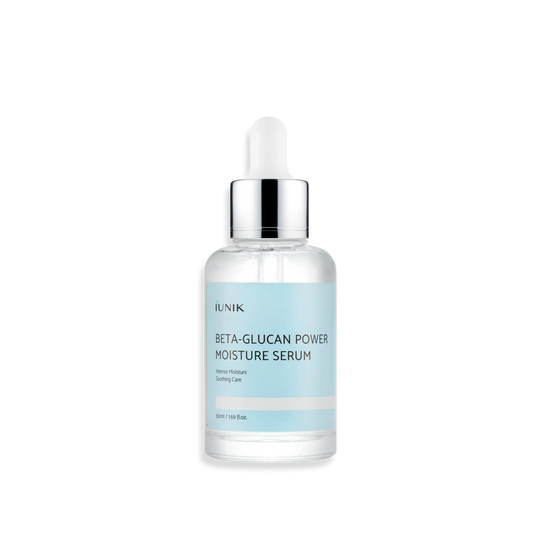

Beta Glucan Power Moisture Serum
Lightweight daily moisture serum
One Ingredient, Built Into Every Step
What makes beta-glucan genuinely different from hyaluronic acid isn't just what it does in a single product it's that it can run consistently through an entire routine, from essence to serum to moisturiser to SPF, compounding its effect at every step.
Beta-glucan serves as the fundamental building block, while Hyaluronic acid functions as an additional benefit.